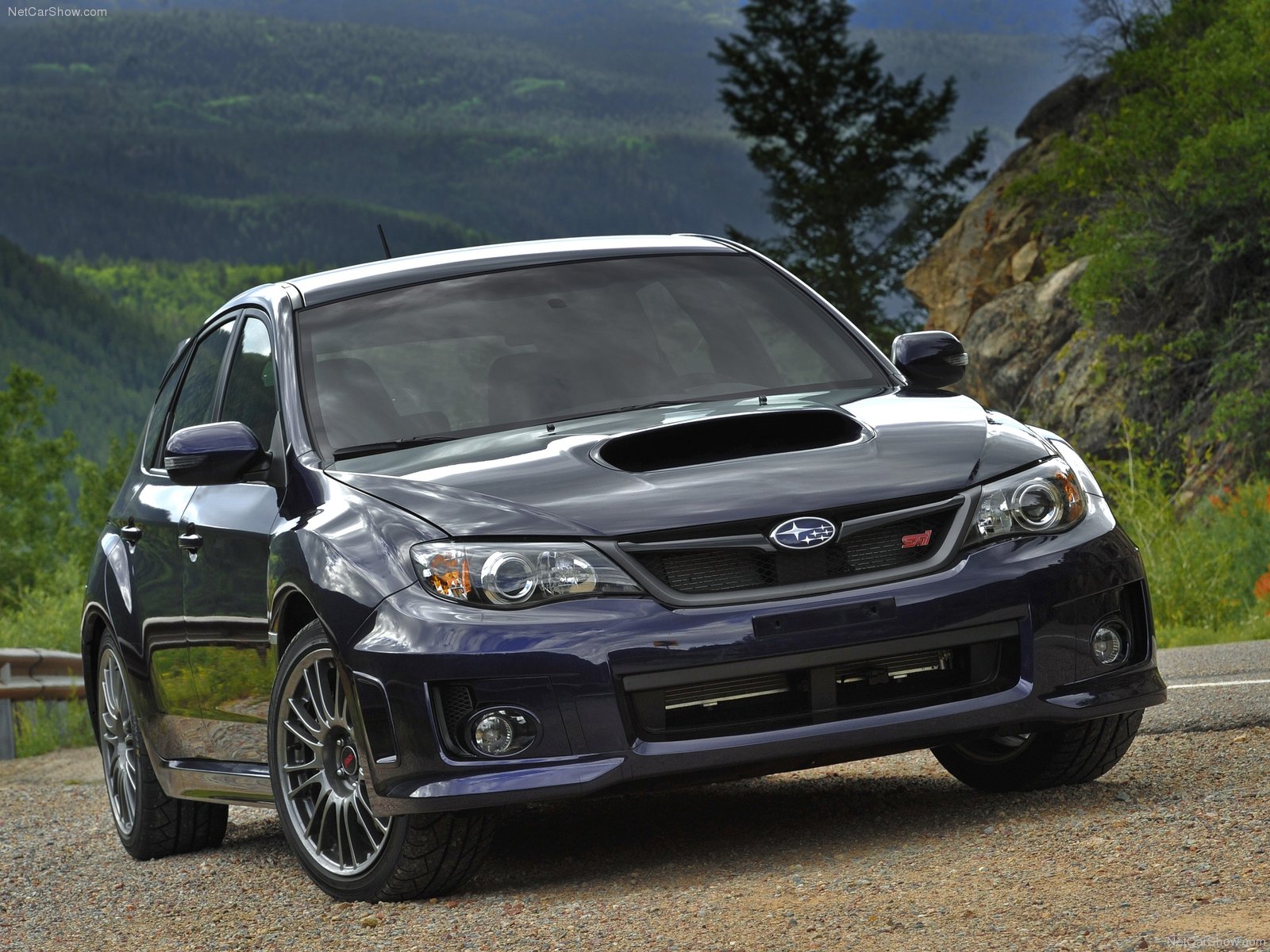
By most accounts, something went awry while Subaru was baking the last generation Impreza WRX STI. Maybe someone slipped in an extra cup of civility or forgot to add enough dashes of hardcore, but what was once little more than a thinly-disguised rally stage escapee had come out of the oven a little weaker than its predecessor. Subaru itself diplomatically admits that the priorities for the last generation STI were somewhat different from the 2011 model. The company stripped the line down to just the five-door hatchback in 2008, stressing functionality over style, and the whole recipe simply felt less focused than what we had come to expect from Japan's all-wheel drive hero.
But that was then, and this is now. The company assures us that for 2011, we can expect a return to the fundamentals that helped establish the STI as a force to be reckoned with. Though the drivetrain remains unchanged, a slew of suspension adjustments and a lower stance have given the STI the ability to hoover up tarmac and gravel stages indiscriminately once again. It isn't a completely new generation – more like a much needed do-over – but the changes are enough to make the 2011 model instantly recognizable from behind the wheel.
If that's not enough to convince you, allow us to direct your attention to the rear of the resurrected four-door body style, dominated once again by the kind of spoiler that could double as a civil engineering exercise. Yeah, baby. The STI is back, and on more than just a wing and a prayer.
In five-door guise, the WRX STI looks much as it did last year. There are a few subtle changes to the fascias front and rear, but otherwise, the body is nearly identical to its ancestor. Buyers and fans alike will be hard-pressed to miss the newest addition to the option sheet, though: the return of the four-door. Subaru hasn't offered the meanest variant of its sedan since 2007, largely because the rally set kept clamoring for a car with a shorter rear overhang. Unfortunately, most American buyers still can't seem to wrap their heads around the concept of a hatch that can get up and go.
Though the base WRX now comes straight from the factory with the same widebody treatment as the STI, you should have no problem picking the more sinister variant out from a crowd. The four-door comes straight off of the boat with an iconic STI rear wing and a smattering of delicious red badges snugged over the grille, fender heat escapes and rear trunk lid. Those with an eye for detail may also pick up on slightly larger 18x8.5-inch wheels and a stance that has been dropped by a marginal four mm. Look closely, and you'll also notice the STI-only Dunlop SP Sport 600 Summer tires, with their gooey Pangaea-sized tread blocks.


Complete with its rear wing, the sedan version of the 2011 STI looks downright menacing. The widebody treatment is easier to spot compared to the five-door version, thanks in part to the bulging rear quarters, and the overall effect is a squat, muscular stance. While the look is a little showy for the less potent WRX, it's right at home on the mighty STI.
Inside, Subaru has included a few tricks to help distinguish its performance trim from the rest of the pack, including leather bucket seats in Limited trim. Just like last year, a few of those sexy STI badges have migrated indoors, situating themselves on the headrests, steering wheel and center console. The designers have removed the majority of the faux-metal trim on the dash in favor of black plastic accents, though the easily-scratched material remains around the shifter. In our experience, the silver-effect trim looks sharp while brand-new, but doesn't stand up to the wear and tear of normal use very well. We would just as soon see it all deleted from the cabin.
As we said earlier, the drivetrain is a direct carryover from 2010, though you won't hear us complain. At 305 horsepower and 290 pound-feet of torque, the turbocharged 2.5-liter flat four-cylinder has no problem mustering up jackhammer levels of commotion. Bolted to an excellent six-speed manual transmission and one very adjustable interpretation of the Subaru all-wheel drive system, the go bits can launch all 3,384 pounds of four-door to 60 mph in a scant 4.9 seconds. Driver's unfamiliar with the turbo Subaru philosophy will likely notice a hefty touch of turbo lag, but it wasn't enough to concern us, especially considering how often we kept the tach pointed due north. Surprisingly enough, the sedan's aerodynamics allow it to carry a top speed of 158 mph – three mph faster than the hatch.
Don't think that Subaru has simply dropped a hotter drivetrain and a reworked suspension into the WRX and called it a day, though. The engineers claim that both the sedan and hatch STI platforms are vastly stiffer than their WRX counterparts, thanks largely to a number of high-tensile steel reinforcements sprinkled through the structure to help it handle the extra horsepower. That means that even if you managed to swap all of the necessary STI hardware into a WRX after the two had left the factory, the latter still wouldn't be as quick as the former around your favorite road course.

In order to help the 2011 STI recoup some of its lost menace, Subaru's engineers fitted the car with front springs that are 16 percent stiffer than the bits found on last year's car. Impressive, sure, but not nearly so eye-widening as the 53 percent stiffer rear coils. As a compliment, the car also wears slightly larger sway bars, too – up one mm front and rear to 21 and 19 mm, respectively. Combined with the slightly reduced ride-height, the whole package is designed to help the 2011 STI retake its throne as a first-class tarmac terror, but the icing on the cake has to be the car's new pillow ball bushings where the front wishbones meet the body structure.
Instead of a traditional rubber bushing, Subaru has decided to go with a steel ball nestled in a metal sleeve. While the sleeve is surrounded by thin strips of rubber to help isolate that cabin from some of the noise and vibrations of the suspension, the ball-in-socket design yields significantly lower amounts of lateral flex, helping to keep the STI's camber and toe in check under extreme driving conditions – the kind of stuff we tend to put a vehicle through on the way to the grocery store.


All told, Subaru says the changes have resulted in a .93 g pull on the skid pad. Not a bad improvement over the .90 g of last year's model. Since we can already hear the rancorous cacophony of fan boy keyboards in full assault over the fact that the 2010 WRX STI Special Edition managed a heady .92 g, allow us to point out that the new version borrows nothing suspension-wise from that model. Furthermore, don't expect to see the same stripped-down, less expensive SE in 2011 guise. The car won't make a return for the next model year.
Spring rates and skid pad numbers are interesting and all, but in the end, we only really care about how well the car scoots around a track. Subaru lined us up with both a 2010 and 2011 model and allowed us to clip off three laps on a small road course with each. The differences were night and day. While muscling the 2010 around the course, we were met with a fair bit of understeer and substantially more body roll than expected in a performance machine of STI caliber, especially given the car's otherwise firm ride. That meant that certain turns required a slower entry speed and our overall lap times were not up to par.


Jumping straight into the 2011, we were immediately met with more settled, planted suspension. The STI relied less on its sticky Dunlops to get around the course than its predecessor, and made us feel like we had more skill behind the tiller than we actually possess. For the first time in two years, the STI felt closer to what we remember from the first-generation bruiser – hard hitting acceleration blended with a sophisticated suspension and brake system.
Given the more aggressive spring rates, you'd expect the 2011 WRX STI to handle like hay cart on speed, but as we spent the better part of an hour slithering up and down the tarmac that clings to the mountains around Aspen, Colorado, we honestly couldn't discern a difference in ride quality between the new model and the old. We're assuming there's some fancy damper work going on here, but no one is saying for sure. The brakes remain colossal units from Brembo, complete with four-pot clamps and 13-inch rotors up front and two-piston calipers squeezing 12.6-inch discs out back. The system is fully capable of yanking your fillings out of your teeth if you get too liberal with the middle pedal. Yes, we love it.

We have to congratulate Subaru for rearming the STI. In a world of ever eroding performance in favor of poseur looks and not much else, the company has done an intelligent job of refocusing the car toward what made it a success to begin with. The big question, of course, is how much is all of that aggressive engineering going to cost you? That all depends on what you want out of life. Subaru will be happy to put you in the four-door WRX STI for a mere $33,995 – a mere $1,000 more than the 2010 WRX STI Special Edition went for in 2010 and a full grand less than the standard model.
Things get a little more pricey when you move to five-door trim, though. If you want the functionality of the hatch, get ready to pony up $35,995. Why the extra coin? Subaru is throwing in those sexy BBS wheels as standard equipment on the long-roof version of the car, a $2,000 option otherwise. The real tragedy of this scheme is that no matter how much you pay, you still can't get them the rollers dipped in the gold paint of the old rally warriors. That is, unless you bust out your own can of Krylon. Maybe next year.