Auto Keirning Cars

Reviews Sport Car Collection Of Various Sources

Auto Keirning Cars

Reviews Sport Car Collection Of Various Sources

Auto Keirning Cars

Reviews Sport Car Collection Of Various Sources

Auto Keirning Cars

Reviews Sport Car Collection Of Various Sources

Auto Keirning Cars

Reviews Sport Car Collection Of Various Sources

Monday, April 18, 2011

Report: Volvo and Pininfarina end C70 joint venture

http://www.sportscarsfans.com/images/script/image.php?id=3DCC_4DAC094A

Volvo has announced it will take sole ownership of its joint manufacturing facility with Pininfarina. The Pininfarinia Sverige AB plant in Uddevalla, Sweden, only builds the Volvo C70 convertible. According to Volvo, the changeover will take place in 2013, and the automaker will continue to build C70s at the plant.

Volvo and Pininfarina have been bedfellows at the plant since Volvo began building C70s in 2003. The car moved just over 4,000 units in 2010, down nearly two percent from the 2009 total.

[Source: Autoweek]

Review: 2011 Hyundai Genesis Sedan V6

http://www.sportscarsfans.com/images/script/image.php?id=874E_4DAC08C2

Automakers have been carving the luxury segment into finer and finer slices for generations. Territory that once belonged solely to the likes of Mercury, Buick and Oldsmobile is now the fertile hunting grounds of brands from Acura to Infiniti. Thanks to these relative newcomers, buyers without the cash to jump into Bavarian marks like BMW, Mercedes-Benz or Audi can still plant their derrières on supple leather thrones without having to sell the family farm in the process.

Three years ago, Hyundai leapt into the low-buck luxury fray with the company’s Genesis Sedan – a vehicle that was intended to prove the Korean automaker could strut its stuff up market without the burden of launching a separate dedicated luxury brand just for the occasion. We were impressed with the big Hyundai when it touched down three years ago as a 2009 model, but domestic automakers like Buick and Chrysler have since sharpened their game in a big way. We jumped behind the wheel of the 2011 Genesis Sedan to find out how the vehicle’s first generation has held up before the updated second one arrives as a 2012 model.

Hyundai decided to wade into luxury waters just as the automotive market’s well began to run dry, and in 2009, the company managed to move around 20,000 Genesis Sedan and Coupe units combined – about half its initial sales projections at the time. As industry-wide numbers have begun to clamber back to their pre-fall heights, Genesis sales have increased accordingly, though we have a feeling the figures still haven’t managed to snag that magical 40,000-50,000 unit mark originally imagined by the Hyundai hive-mind.

That’s likely no fault of the vehicle’s styling, though. There’s no denying that the 2011 Genesis Sedan still carries the same high-brow presence of its forebearers thanks largely to one massive, stylized rib-cage grille. Hyundai still hasn’t set about slapping a big H on the hood, and from the front, uninitiated onlookers may have a hard time discerning the vehicle from the Lexus GS bloodline. From the side, the vehicle borrows cues from BMW’s styling department with wrapped headlights and taillights as well as a shark-fin antenna. Large ovular exhaust exits dominate the lower rear fascia and a single Hyundai badge on the rear trunk deck is the only indication that this beast comes from anywhere other than Japan.

2011 Hyundai Genesis Sedan side view2011 Hyundai Genesis Sedan front view2011 Hyundai Genesis Sedan rear view

When the Genesis Sedan debuted, it came packing an interior that was several light years ahead of what Hyundai had turned out in the past. Dominated by plenty of excellent stitching, perforated leather and attractive wood accents, the cabin made it clear that the Korean sedan wasn’t playing around. Since then, the cockpit has received few updates, and while still a nice enough place to spend time, interiors from both Buick and Chrysler have finally gotten a chance to play catch-up.

Both of those automakers have suddenly taken this whole auto manufacturing thing seriously, and as a result, vehicles like the 2011 Buick Lacrosse and Chrysler 300 are now available with cabins that can easily eclipse the Genesis in terms of design and quality, at least for a price. And that’s one point that the Genesis Sedan still has on the lower-luxury domestic marks. The Korean four-door comes standard with heated and cooled leather seats up front, slightly raised seating out back with plenty of legroom and wood grain trim throughout as well as tech treats like adaptive cruise control and dual-zone automatic temperature control for a mere $33,000 plus an $850 destination charge.

2011 Hyundai Genesis Sedan interior2011 Hyundai Genesis Sedan front seats2011 Hyundai Genesis Sedan gauges2011 Hyundai Genesis Sedan dash trim

If you want those goodies in either the Lacrosse or the 300, expect to pay similar money. Opting for the leather-clad nicety of the TriShield will see you staring at an MSRP of $33,765 plus destination for the Lacrosse CXS, while the 2011 Chrysler 300 Limited comes to the dance wearing a price tag of $31,995 including destination. Don’t expect to find heated or cooled seats or dual-zone climate control from the 300, though.

The only place that the Genesis sedan really shows its age is in its dated interior lighting and flimsy switches, most notably for the heated and cooled seats and window mechanisms. Whereas both Buick and Chrysler have made sure to incorporate solid-feeling interfaces, the Hyundai simply doesn’t pack the same feel of quality.

2011 Hyundai Genesis Sedan instrument panel2011 Hyundai Genesis Sedan 6 DVD changer2011 Hyundai Genesis Sedan shifter2011 Hyundai Genesis Sedan multimedia system controls

Our tester came with the company’s lively 3.6-liter V6 mated to a six-speed Aisin automatic transmission that shuffles power to the rear wheels. With 290 horsepower and 264 pound-feet of torque on hand, the six-cylinder has no problem moving the vehicle’s 3,748-pound curb weight along, especially given the EPA’s fuel economy rating of 18 miles per gallon city and 27 mpg highway. During our time behind the wheel we saw around 23 mpg combined.

Those numbers put the Genesis Sedan 10 horsepower ahead of the 3.6-liter V6 found in the Lacrosse CXS and just two horsepower behind the same displacement V6 in the Chrysler 300. Interestingly enough, fuel economy for all three vehicles is nearly identical at 22-22.5 mpg combined.

2011 Hyundai Genesis Sedan engine

With that in mind, it’s easy to get the impression that all three of these vehicles are neck-and-neck contenders, but that reality fades from view after a little time behind the wheel. Hyundai still has an excellent driver in the Genesis thanks largely to the vehicle’s front-engine, rear-wheel-drive configuration. Plop your foot on the accelerator and the big four door moves forward without any of the scrambling drama of the front-wheel-drive Lacrosse.

But make no mistake, this isn’t a sports sedan by any stretch of the imagination, although acceleration is more than ample and handling is predictable without being twitchy. Jump onto the interstate and the Genesis delivers a quiet cabin free of engine, tire or wind noise, and the six-speed automatic transmission has no problem landing on the correct gear for hard-throttle passes.

2011 Hyundai Genesis Sedan rear 3/4 view

Hyundai curiously provides flappy paddles for making your way through the six cogs in the gearbox should you get bored letting the vehicle’s ECU do all the work. The transmission delivers fairly rapid shifts, though the trickery doesn’t do much to lend the sedan any of the sporting tones of its two-door twin. We’re guessing that the paddles are significantly more at home with the optional 385-horsepower V8 engine and ZF six-speed transmission.

Despite showing a few gray hairs here and there, the 2011 Genesis Sedan is still more than capable of holding its own in the budget luxury market. While its heaps of standard equipment and nicely appointed interior are all strong points on its résumé, the Genesis still holds one massive trump card over its competition – a 10 year, 100,000 mile warranty. While we can’t wait to drive next year’s Genesis R-Spec with its 429-horsepower 5.0-liter V8, the current model is a no-worry ace.

[Source: autoblog]

Friday, April 15, 2011

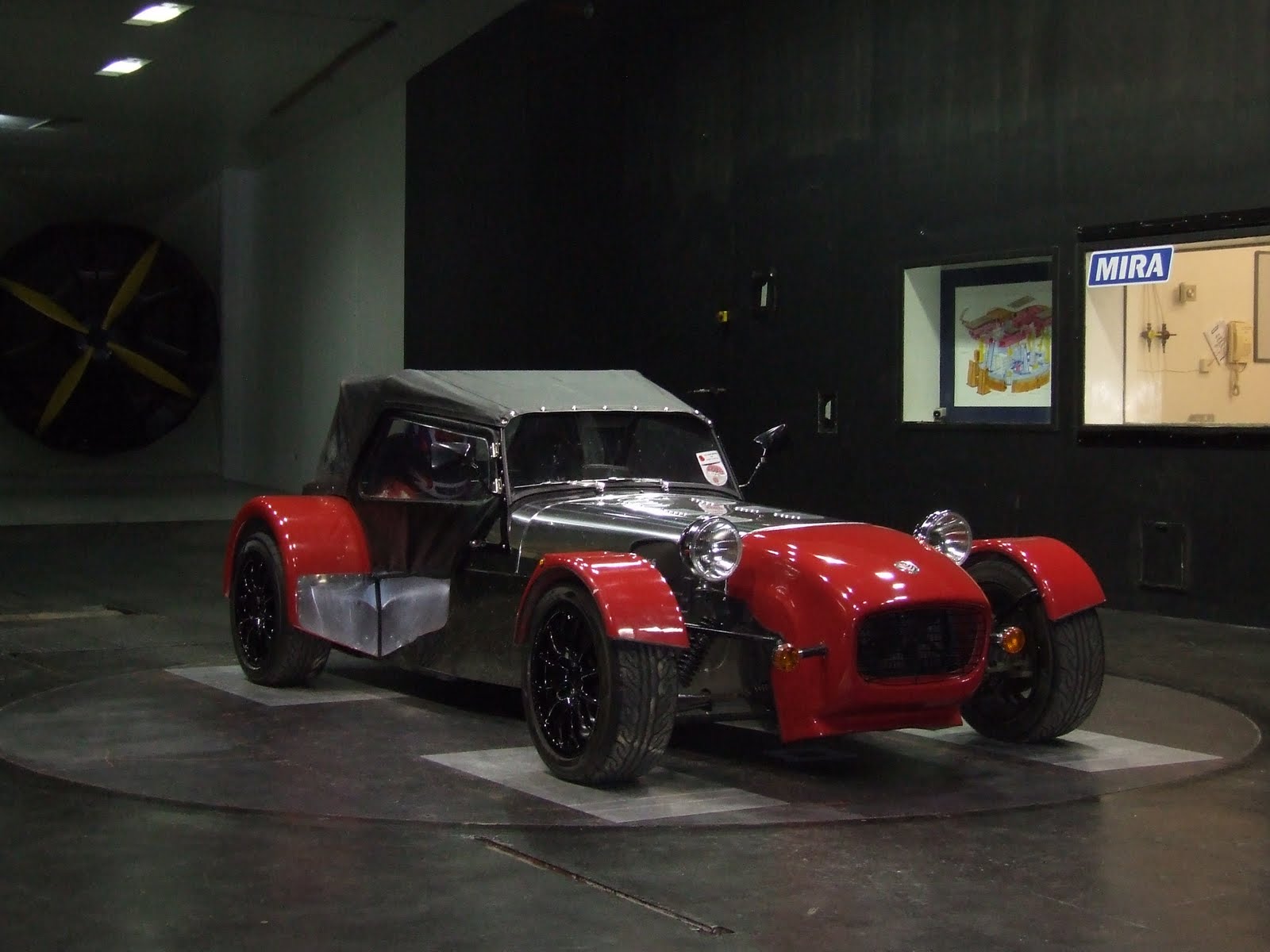
ZERO GOES TO MIRA FOR A WIND TUNNEL TEST.............


Earlier this week the Great British Sports Cars Zero went for a test at Mira using there extensive wind-tunnel and aerodynamic wind tunnel facilities. The Zero did incredibly well for a seven type car, helped by its splitter on the nose cone and diffuser, some new parts were also tested which will soon be available which should further enhance the performance.

For more information about the Zero please visit our website www.greatbritishsportscars.co.uk and for parts and spares please visit www.kitspares.co.uk. You can now become a fan of GBS on Facebook


Thursday, April 14, 2011

ZERO DEMONSTRATOR GOES ON A TRACK DAY……………


At the weekend we took the Zero demonstrator for a track day at Barkstone Heath. It was a great day and the performance from the Zero was excellent. I went around with both Richard and Keith who was a former rally driver and was amazed at his driving and the handling and speed of the Zero, I really enjoyed it and can’t wait for the next track day. We will let you all know when we plan the next track day.

To book a test drive in our Zero Demonstrator, please call 01623 860 990.

Please visit our website www.greatbritishsportscars.co.uk for more information about the Zero and for parts ans spares please visit www.kitspares.co.uk. Kit Spares now has more Gulf Oil Products as well as AT Power, Smiths Gauges and many more products. Become a fan of GBS on Facebook

Wednesday, April 13, 2011

Porsche planning Ferrari 458 challenger?

http://www.sportscarsfans.com/images/script/image.php?id=8C5F_4DA5B486

Porsche would like to double its current sales volume, and to do that, the automaker will need to expand its lineup. The Cajun crossover and 918 are still a year or three away, and we’re always hearing talk of a sub-Boxster roadster or even a baby Panamera being in the cards. But what about a new coupe to take on Maranello’s finest?

Autocar claims that such a supercar could be on the way, and it would go toe-to-toe with the Ferrari 458 Italia. The British mag reports that Porsche boss Mathias Muller would like the company to produce another mid-engine offering, adding “we’re thinking above the 911 but below the 918 Spyder.” Muller also says that Porsche already has some designs that still need further development, and that a business case still needs to be made.

If such a Porsche were to find its way to production, it would need plenty of lightweight materials. And since Audi now shares a family tree with Porsche, the new supercar could share the R8’s aluminum space frame chassis. If that doesn’t work, a heavily-modified (and larger) 911 platform would probably do the trick, too.

At any rate, such a super-Porsche appears to be a long way from a production green light, much less a showroom floor. Still, it’s nice to dream, and we don’t mind waking up to a world with one more Porsche from which to choose.

[Source: Autocar | Image: Michael Harley/AOL]

Infiniti confirms plans to launch in Australia

http://www.sportscarsfans.com/images/script/image.php?id=24E3_4DA5B427

Infiniti has big plans to expand beyond North America, and Drive reports that the Japanese luxury automaker intends to include Australia in its expansion. The site says that officials at Nissan have officially announced that Infiniti would head Down Under by September 2012, adding that the brand would start off with three stand-alone dealerships in Melbourne, Sydney and Brisbane.

When those dealerships launch, there will only be three Infiniti products from which to choose. The G37 coupe and convertible, the M sedan and the FX crossover were chosen in part because of their freshness in the market. Infiniti has reportedly decided against exporting the high volume G37 sedan to Australia, opting instead to wait until the next generation model goes prime-time. The Australians will be able to choose from the same 3.7-liter V6 and 5.0-liter V8 options we have here in the States, and they’ll also be able to pick a 3.0-liter diesel that we aren’t afforded.

The folks at Infiniti also hinted at their strategy for the brand. Infiniti brand GM Kevin Snell reportedly told the press at a launch event that the brand wouldn’t try to be the “cheapest” make Down Under, adding that Infiniti models are often better-equipped than the competition from Europe.

[Source: Drive]

Review: 2011 Mitsubishi Outlander Sport SE AWC

http://www.sportscarsfans.com/images/script/image.php?id=EEA8_4DA5B347

Mitsubishi has a problem with its current lineup. Unless you’re looking for a Lancer, your options are limited to the Galant mid-size sedan and the Endeavor and Outlander crossovers. Right now, the Galant is contemplating seppuku and the Endeavor hasn’t been fully redesigned since it first went on sale back in 2003. The Outlander, however, has something positive to offer. It seats up to seven passengers (in a pinch), has been named an Insurance Institute for Highway Safety Top Safety Pick, and tops out at 28 miles per gallon on the highway.

Mitsubishi knows having just two competitive vehicles to choose from isn’t enough to compete in an industry eager to fill every niche, and the company appears focused on evolving the two lone bright spots in its lineup. The Lancer has spawned many variants, the latest being the Lancer Sportback, a fun-to-drive wagon that doesn’t step on the toes of the top-trim Lancer Evolution. The Outlander, meanwhile, recently gave its name to the smaller 2011 Mitsubishi Outlander Sport, a five-passenger crossover looking to make its mark in a currently crowded segment.

If the 2011 Mitsubishi Outlander Sport had a favorite song, it would be Sister Sledge’s “We Are Family.” There’s no mistaking this CUV for anything other than a product from the diamond-star family. The gaping mouth and muscular haunches leave no doubt that the Outlander Sport got the “good genes” after a night of passion between a Lancer Evo and the larger Outlander. And despite sharing the name “Outlander” with its larger three-row brother, the Outlander Sport is its own vehicle, a compact crossover different in size, shape and demeanor.

Up front, for instance, a jet-fighter nose kicks off an aggressive forward-leaning stance. Sharply cut headlights dig into the face of the Outlander Sport while the roof line pulls tightly rearward along the 169.1-inch long body. That length is almost 15 inches shorter than the larger Outlander, despite the two crossovers sharing the exact same wheelbase and almost the same width. Like a Beverly Hills housewife with a face-lift, this look has to be done correctly or things can quickly turn into a cat-faced disaster. Fortunately, Mitsubishi’s corporate face survived the transplant with nary a scar to show for it. A set of 10-spoke 18-inch alloy wheels wearing Goodyear Eagle 225 55R/18 rubber shoes also sit neatly below the ever-so-slightly bulging fenders. These larger wheels come standard on our SE tester, while 16-inchers are standard running gear for the lower-trim ES.

2011 Mitsubishi Outlander Sport SE AWC side view2011 Mitsubishi Outlander Sport SE AWC front view2011 Mitsubishi Outlander Sport SE AWC rear view

Inside, the Outlander Sport prefers muted tones, with dark plastic and black cloth the only interior color choices available. Fortunately, the controls are laid out in a simple manner, and we appreciate the climate controls relying on three traditional dials instead of being relegated only to touch-screen control. That screen is left to handle audio and navigation, which it does rather well being responsive to the touch with crips graphics. Pop into Reverse and you’ll also get a nice view of what’s going on behind the Outlander Sport thanks to the back-up camera that’s bundled with the $2,000 nav system.

Unfortunately, laying down two grand for navigation also forces you to opt for the $1,800 Premium package that adds a panoramic glass roof, LED interior mood lighting, a Rockford-Fosgate sound system, Sirius satellite radio and an in-dash six-disc CD changer. All told, you’re on the hook for almost $4,000 worth of options if you want the Outlander Sport to tell you where to go.

2011 Mitsubishi Outlander Sport SE AWC interior2011 Mitsubishi Outlander Sport SE AWC front seats
2011 Mitsubishi Outlander Sport SE AWC paddle shifter2011 Mitsubishi Outlander Sport SE AWC tachometer

Sound from the optional Rockford-Fosgate audio system is pushed out to your ears courtesy of nine-speakers, a 10-inch subwoofer in the rear cargo area and 710 watts. Surprisingly balanced, this particular sound system has lost the overbearing bass that used to be a hallmark of Rockford-Fosgate systems.

If you plan on listening to your iPod, Mitsubishi also includes a connector that lets you control the device from the touch-screen or steering wheel-mounted controls. Annoyingly, however, the stereo takes about a minute to recognize the mp3 player each time you turn off the car, and once it does, playback starts from the first song on the unit. It’s like teaching your dog to sit, and every time you turn around the pooch forgets where his butt goes. In a word: frustrating.

What’s not frustrating is the level of supportive comfort provided by the front seats. Headroom is also a non-issue and visibility is great regardless of where you’re looking. The cabin is relatively simple, aside from the touch-screen, but it works in the Outlander Sport’s favor.

2011 Mitsubishi Outlander Sport SE AWC audio system2011 Mitsubishi Outlander Sport SE AWC audio system

If you go for a base two-wheel-drive ES model, the Outlander Sport starts at just $19,275. Our all-wheel-drive SE model starts at $22,995 (plus $780 in destination charges), and thanks to a few of those aforementioned fixings reaches $28,570. The Outlander Sport AWD SE’s base price, however, is below that of the Honda CR-V EX-L ($26,645), Hyundai Tucson Limited ($26,345) and Kia Sportage EX ($24,795). Equipped like this Outlander Sport, the Kia and the Hyundai are just a few dollar bills away from $30,000 and the Honda climbs past by a Benjamin. So paying over $28,000 for this compact crossover becomes a little more palatable when compared to more expensive competition, and it’s made even more so once you raise the hood.

Pull the lever and prop up the sheet metal and you’ll see a familiar 4B11 face smiling back at you. Used throughout the Mitsubishi lineup, this 2.0-liter inline four-cylinder engine produces 148 horsepower at 6,000 rpm and 145 pound-feet of torque at 4,200 rpm. That may not sound like much oomph to propel the all-wheel-drive Outlander Sport, but at just 3,263 pounds, it feels quicker than it should be.

2011 Mitsubishi Outlander Sport SE AWC engine

The Outlander Sport isn’t fast by any means, but the four-cylinder engine gets the job done while returning 24 miles per gallon around town and 29 mpg on the highway. Two-wheel-drive models do even better at 25 city/31 highway. By contrast, the 2011 Honda CR-V, Hyundai Tucson and Kia Sportage are 240, 103 and 92 pounds heavier, respectively. Each vehicle also produces more horsepower (32 hp for the Honda and 28 hp for the Kia/Hyundai) and torque (16 lb-ft for the Honda and 23 lb-ft for the Kia/Hyundai) yet return slightly worse fuel economy (21/27 for the Honda and 21/28 for the Kia/Hyundai).

It’s not just the weight that helps the Mitsubishi Outlander Sport in the fuel-economy equation. Connected to that 2.0-liter engine is a Continuously Variable Transmission, or CVT, which can be manually “shifted” via a pair of steering wheel-mounted paddles. CVTs are notoriously buzzy contraptions, and the one employed in the Outlander Sport is no exception. Truth be told, the engine and transmission combination would be rather dull without those flippers for manually controlling the fun.

2011 Mitsubishi Outlander Sport rear 3/4 view

The Outlander Sport does have a few tricks up its sleeve besides being able to fake a gear shift. It handles surprisingly well for what’s essentially a high-riding, tall-roof wagon. The brakes are quite responsive once you push past the first inch of light pedal travel, but over bumps, the tight Lancer-like suspension reveals some flaws in the Noise Vibration and Harshness department. There was some chatter inside the cabin of our test vehicle and, when rolled down a bit, the windows produced a slight rattle. We could chalk up the window rattle to press-car jitters, but the cabin chatter is probably there to stay.

Those problems aren’t enough, however, to make us forget the sporty handling, accommodating interior and competitive pricing of the 2011 Mitsubishi Outlander Sport SE AWC. Will it become Mitsubishi’s third bright spot behind the Lancer and Outlander? The company is crowing that 1,290 units of the Outlander Sport were sold last month. That’s peanuts compared to the Honda CR-V, which sold over 19,000 units, but does represent nearly a fifth of the entire brand’s sales. That’s remarkable for a model only a few months old, and tells us that Mitsubishi is giving buyers exactly what they want.

[Source: autoblog]

Share

Twitter Delicious Facebook Digg Stumbleupon Favorites More